Subscribe To


 Posts
All Comments
Posts
All Comments
Wednesday, March 11, 2015
This Garden Cooks! : The Victorian Garden
This Garden Cooks! : The Victorian Garden: What do carpet beds, moon gardens, cottage gardens, specimen trees, snowball bushes, and fragrant peonies have in common? They're all p...


The Victorian Garden
What do carpet beds, moon gardens, cottage gardens, specimen trees, snowball bushes, and fragrant peonies have in common? They're all part of the tapestry that made up the American Victorian-era garden.
For years, I've scoured used book stores, antique shops, flea markets and garage sales for garden photographs, catalogs, books and other ephemera. One of my favorites are the old photo postcards created around 1900, especially those in which a proud homeowner shows off his house and garden, whether it's a small farmhouse or a spacious Victorian-era frame house with an elegant double porch. Rather than a foundation planting of yews or juniper, here is a lovely combination of annuals, perennials and vines. This card made its way to Reddick, Illinois, home to the Reddick mansion and many other fine turn-of-the-century houses.
Learn more about the Victorians and their home gardens in a special class, The Victorian Garden on Saturday, March 21 from 1-3 p.m. at the Chicago Botanic Garden in Glencoe.


Friday, March 14, 2014
Paint Your Garden with Plants -- Two Classes at the Chicago Botanic Garden
I like to think of my garden as part coloring book, part laboratory. Each year, I play with annuals and perennials to create new color combinations -- with plants that benefit insects and birds.
On Saturday, March 29, I'll be teaching a 2-part class, "Paint Your Garden with Plants," at the Chicago Botanic Garden in Glencoe:

Designing the Sunny Perennial Garden 10 a.m. – noon and
 Designing the Shade Garden 1 – 3 p.m.
Linnaeus Room
$52/$65 for both sessions at 10 percent discount
The classes are filling up fast. For more information, visit www.chicagobotanic.org or call (847) 835-5440.

Thursday, March 6, 2014
From an English Garden: Revisiting Great Dixter with Fergus Garrett

At some point in a gardener’s life, he or she will likely come across the writings and photographs of the renowned gardener and garden writer Christopher Lloyd (1921-2006). Lloyd gardened at his family’s estate, Great Dixter, in Northiam, East Sussex, in the south of England. The wonderfully atmospheric and picturesque garden surrounds a rambling fifteenth-century Tudor-style manor house that continues to draw thousands of visitors each year.
A charismatic and highly opinionated gardener, Lloyd was capable of inspiring others through his written and spoken word. His head gardener and renowned plantsman, Fergus Garrett, carries on Lloyd’s unique gardens. Garrett will be at the Chicago Botanic Garden on Monday, March 24 from 2 to 4 p.m. to discuss the thought process involved in creating vibrant plant combinations where colors are used to maximum effect. Great Dixter’s beds and borders paint a powerful, vibrant and adventurous picture, one that is sure to inspire you as you think about planting your own garden this year. After the presentation, he’ll be joined by local plantsman Roy Diblik to continue the discussion.
The fee is $37 for nonmembers; (members receive 20% discount). To register, visit chicagobotanic.org/school or call 847-835-8261
Sunday, March 2, 2014
A winter's tale of birds and beans

The 2.9 inches of snow we had this weekend brought many more birds to the feeders outside our kitchen window. A lone starling was joined by sparrows, house finches, downy woodpeckers, 7 cardinals, goldfinches, which are beginning to show faint yellow feathers as they lose their winter plumage, mourning doves and the occasional Cooper's hawk, which sends the small birds scattering. It's a good time to be indoors cooking and sowing seeds of tomato and pepper plants. As soon as the snow melts, I'll get my soil thermometer and when the top inch of soil reaches to 52 degrees or so, I'll begin sowing kale seeds. Kale is the current darling of foodies and cooks. It's rich in nutrients, it provides fiber and it's tasty.
Red Russian has smooth red leaves and you can harvest them in about 25 days. I like the curly varieties like Redbor, Toscano (the "dinosaur" type), and curly Scotch or Dwarf Blue Curled Vates with their blue leaves. Kale is a member of the Brassica (cabbage) family, but even if you don't like cabbage, you may enjoy this leafy green, which can be steamed, sauteed, used in omelets and in soup.
Here's a winter kale recipe that's easy to make.
Red Russian has smooth red leaves and you can harvest them in about 25 days. I like the curly varieties like Redbor, Toscano (the "dinosaur" type), and curly Scotch or Dwarf Blue Curled Vates with their blue leaves. Kale is a member of the Brassica (cabbage) family, but even if you don't like cabbage, you may enjoy this leafy green, which can be steamed, sauteed, used in omelets and in soup.
Here's a winter kale recipe that's easy to make.
Kale with Cannellini Beans
2 pounds of curly kale (2-3 large bunches)
Salt and pepper
1 medium onion, diced
1 1/2 T olive oil (I like basil-infused oil, but you can use any good olive oil)
2 large garlic cloves, minced
1/4 tsp red pepper flakes
2 tsp chopped fresh rosemary
1/2 cup dry white wine
15 oz can of cooked cannellini beans, rinsed well
Freshly grated Parmesan or Parmigiano reggiano cheese
Curly leaved kales have tough ribs and stems. Fold the leaves in half and remove the entire stem/rib before cooking.

Put a quart of water in a deep pan and add 1 tsp salt. Bring to a simmer and add the kale. Simmer for about 10 minutes until tender. Drain the kale (and reserve the water for another use--you can drink it or add it to soup). Heat the oil in a large skillet and add the onion, garlic, red pepper flakes and rosemary and saute for about 3 or 4 minutes.
Add the wine and continue cooking for another 4 minutes.

Chop the kale into small pieces. Add the beans and kale and cook a few more minutes to heat. Place in a bowl and sprinkle parmesan on top. Good as a side dish or enjoy as a warm salad with some fresh French or pumpernickel bread.
Add the wine and continue cooking for another 4 minutes.

Tuesday, February 11, 2014
It's right around the corner...

Tuesday, February 4, 2014
Word-free (almost) Wednesday

Monday, January 27, 2014
The Good Old Days

For the past 15 years, I've researched what makes the midwest American garden so unique. I've collected old catalogs, books and photographs, many of which are more than 120 years old. But some things, like this beautiful 1893 Vaughan's Seed Store catalog from Chicago, can only be found in the archives of The Morton Arboretum Library in Lisle, Illinois. Check out www.mortonarb.org
I love the marketing that went on in Victorian-era seed catalogs. Some things never change. The so-called simple flowers of old gardens were not that simple. Gardeners back then were bombarded with newer, bigger, better, more colorful annuals. There was an incredible influx of plants and seeds brought into the U.S. The canna lily flower on the cover is spectacular (and a trendy plant again for today's tropical-inspired gardens). But, it's the slogan, "Gardening is an employment for which no man is too high or too low" that hits home. In other words, send us 35 cents and we'll send you seeds for some of the newest annuals so that your tiny garden can look just like the big estate gardens.
This particular catalog was issued the year of the 1893 Columbian Exposition--the World's Fair--in Chicago. “Opening the Vaults: Wonders of the 1893 World’s Fair” is a special exhibit at Chicago's Field Museum, which will run through Sept. 7, 2014. Now, you can get a rare view inside The Field Museum’s vaults to see incredible artifacts that bring to life one of the most spectacular events in the Windy City’s history.
The Field Museum is at1400 South Lake Shore Drive, Chicago; 312-922-9410, fieldmuseum.org.
Monday, January 20, 2014
Monday Musing
Scarecrow. Door County, Wisconsin. I drove past this house and then decided to come back and have a better look. A whimsical little vignette.

I'm in search of the perfect scarecrow, but have yet to find the right one. This one was cute from the Evanston Garden Walk a few years ago. I have weeping spruces. This could work.


This is Debbie Rea's wonderful scarecrow in her lovely, organized vegetable garden. Not a crow around but plenty of herbs and veggies.

My brother Greg makes an AWESOME scarecrow but he doesn't really want to be out there for more than 10 minutes. Besides, he has his own pepper patch -- several hundred hot peppers from around the world -- that he nurtures. And he even overwinters a few pepper plants indoors each year.


Evanston Garden Walk school garden. The kids at this elementary school did a great job designing the scarecrows.

How clever---a face made from a colander filled with ornamental fruit.
This would be the ultimate scarecrow. A gigantic horse. My Spouse is checking out its knee. How did the Frederick Meijer Gardens ever get this on the property. No horsing around.

I'm in search of the perfect scarecrow, but have yet to find the right one. This one was cute from the Evanston Garden Walk a few years ago. I have weeping spruces. This could work.
One year, my scarecrow wore this shirt with the slogan, "Enough is just a Little Bit More," a slogan I spotted on a bench in Cedarburg, Wisconsin. But what the heck does that mean? Just when you think you have enough it's actually more than you need? I still need a few more scarecrows.
Here's a potential scarecrow. This is Mad Mom from the Frederik Meijer Sculpture Gardens in Michigan. You have to see that place--great gardens, sculptures and live music of all sorts. Wonderful.
This scarecrow watched over the basil patch, here going to seed one fall. It's too bad this scarecrow can't scare off basil blight.
This is Debbie Rea's wonderful scarecrow in her lovely, organized vegetable garden. Not a crow around but plenty of herbs and veggies.
My brother Greg makes an AWESOME scarecrow but he doesn't really want to be out there for more than 10 minutes. Besides, he has his own pepper patch -- several hundred hot peppers from around the world -- that he nurtures. And he even overwinters a few pepper plants indoors each year.
Another year in our garden. Standing guard over the Brassicas for late fall harvest. Cabbage butterflies ignored it.
Evanston Garden Walk school garden. The kids at this elementary school did a great job designing the scarecrows.
How clever---a face made from a colander filled with ornamental fruit.

This would be the ultimate scarecrow. A gigantic horse. My Spouse is checking out its knee. How did the Frederick Meijer Gardens ever get this on the property. No horsing around.
Friday, January 17, 2014
Here's to Hue
The snow is about to start flying again this weekend with another 1 to 3 inches in the forecast. This is a good time to hunker down and start thinking about how to refine the mixed perennial-annual-shrub border. Cool colors--mauve, purples, pinks and blues--have always been a favorite, but it's tempting to do a hot-colored garden outside the vegetable garden.
Hot (or warm) colors like reds, oranges, orange-yellow, can provide eye-popping color at a distance whereas blues and violets fade away. That was the case this summer when I planted Salvia guarantica, Salvia farinacea and dusty miller outside the picket fence, which is about 80 feet from the house. They flowers disappeared against the vanilla-white fence. Time to rethink that planting.

A nice clump of bold cannas--the combination above (red salvia, canna, zinnias and dahlias)--courtesy of The Morton Arboretum in Lisle, Illinois (www.mortonarb.org) would provide a focal point against the veg garden arbor. And all of the flowers on these annuals attract hummingbirds and other pollinators.

And, where there's not a lot of space--on a deck or patio, for instance--I could still do a few sizzling-hot combinations, like this one above--plectranthus and caladium. Great colorful foliage for a shaded spot.
One other thing I'll be looking at is how to combine more contrasting shapes in the mixed border. The stachys and coreopsis above works well but I'll be doing this in larger blocks throughout this long, deep border.
Now, where is that snow shovel? Enjoy your weekend.
Tuesday, January 14, 2014
Looking Ahead: One gardener resolves to reflect, read and bloom

For those who missed my essay in the Sunday, January 13 Chicago Tribune...
“Half the interest of a garden is the constant exercise of the imagination. You are always living three, or indeed six, months hence.” -- Alice Morse Earle, “A Taste for Gardens” (1897)
In the coming weeks, snowdrops will push their leaves through the frozen soil and unfurl their delicate little bell-shaped flowers. But gardening season remains a long way off so I stare out the window. And reflect. The occasional snowfall in the past month has concealed or at least relieved many of the little errors I’ve planted over the years. There are the shrubs--viburnum, ninebark and weigela--that outgrew their intended space. There are hordes of non-native grasses that decided to sow themselves around the perennial border and elsewhere. There’s the small grove of river birches that, in retrospect, should have been the more attractive alders, or swamp white oaks that hold their burnt umber leaves throughout the winter. Who knew?
And so I resolve to “fix” this year’s garden with a few resolutions. But before I put pen to paper in my garden journal, I checked with a few other gardeners to learn their New Year’s intentions.
Susie and Rich Eyre of Rich’s Foxwillow Pines in Woodstock have practical plans for the conifer and perennial gardens surrounding their 19th Century farmhouse. “Our garden resolutions for 2014 are to use more compost, more water, and more mulch,” Susie said. (I make a secret note in my garden journal that she said nothing about adding plants. I’ve seen their garden. I predict they will add many plants but she doesn’t realize it right now.)
Jean Starr, editor of the Midwest Peony Society newsletter, is a realist. She admits that just because you have a resolution doesn’t mean that it can’t cover multiple growing seasons. “My resolutions are usually a carry-over from previous years. They include adding organic fertilizer in the form of compost or composted manure.” Check. “I’m not adding anything new until I remove the plants I don't intend on keeping.” Check. “I plan to continue indulging my penchant for unusual plants because that's one of my main reasons for gardening.” Check. (Jean loves perennials, especially peonies and day lilies. I make another secret note that she is going to buy many new plants that will patiently wait in their pots for a spot in her garden in Chesterton, Indiana, while she decides which existing plants to evict.)
Garden designer Patti Kirkpatrick of Joliet is still pondering what she might do this spring. “I guess my gardening resolutions for 2014 would be to plant more suitable-for-drying species to make an all naturally decorated Christmas tree this year, reclaim my neglected edges, and replace more fences in need of repair.” (I make a secret note in my garden journal, resolving to be more like Patti Kirkpatrick in 2014: thin and ballerina-like. With a knockout garden.)
A few snowflakes are falling as I look out toward our big vegetable garden. When the wooden picket fence surrounding it finally began to rot last fall, we dismantled it. (When I say “we” I mean My Spouse. My ever-patient spouse who admitted that his resolution this year is to not move any more small trees that I’ve planted no matter what.) Fence shopping is boring in the middle of winter, so before I begin making concrete resolutions (besides the usual ones--lose weight, eat healthy, exercise, etc.), I turn to my bookshelves in search of a distraction.
I come across the American poet Ogden Nash, who in 1943, penned “My Victory Garden.” The poem’s last stanza is my favorite:
"My farming will never make me famous,
I'm an agricultural ignoramus,
So don't ask me to tell a string bean from a soy bean.
I can't even tell a girl bean from a boy bean."
My resolutions last year focused on growing edibles, including beans of all types, along with “add more tomato plants, get the soil tested, put in raised beds, take out more lawn, put in some apple trees.” A few of these things were much easier to accomplish than my annual, yawn-provoking “exercise regularly” resolution.
I page through a slender volume, “In Your Garden,” a 1951 collection of newspaper articles by Vita Sackville-West, whose English garden, Sissinghurst, continues to draw visitors long after her death in 1962. In one winter column, she wrote about planning a grey, green and white garden--an ethereal moon garden to be enjoyed on a summer evening.
“I cannot help hoping that the great ghostly barn owl will sweep silently across a pale garden, next summer, in the twilight--the pale garden that I am now planting, under the first flakes of snow.”
And then it dawned on me. My gardening resolution is not about gardening. What I really want to do is sit in my garden and observe rather than work feverishly kneeling and planting, dividing, edging, watering, fertilizing, pruning and tweaking. And so I revisit one of my favorite quotes by James Douglas from his 1930 book, “Down Shoe Lane.”
“It is a good idea to be alone in a garden at dawn or dark so that all its shy presences may haunt you and possess you in a reverie of suspended thought.”
A reverie of suspended thought. Into my garden journal goes this year’s only resolution: “Read More, Weed Less.” (I make a secret note to revisit that entry frequently.)


What are your garden resolutions for the year?
Tuesday, November 19, 2013
Frost
Over the summer, friend and photographer Ellen Hodges has captured all sorts of wonderful moments--from insects and birds to buds and flowers--in Wildwood, my garden. Although frost and a few evenings of below-freezing temperatures this month have finished off the last of the fall flowers, there's still beauty to be found in the lingering colors and textures, especially when dusted with early morning frost. There's still time to get out in your garden or in a public garden to enjoy the show.


Photos (c) Ellen Hodges
Wednesday, November 13, 2013

Thursday, June 20, 2013
Celebrating the Solstice
My garden is part coloring book, part laboratory. There are the plants and ever-changing color combinations to muddle with. And, there are the experimental plants that are magnets for butterflies, hummingbirds and songbirds. The garden is part art, part science.
Cedar waxwings, robins and the occasional chipmunk have pilfered the serviceberry fruits this week. The black swallowtail caterpillars are chomping the common rue. And the hummingbirds have discovered the lantana. And today is the last day of spring. Plenty of time to explore more plants combinations, and visit one of many gardens that will be on walks this weekend and through July. For a list of Garden Conservancy walks near you, check out www.gardenconservancy.org


Cedar waxwings, robins and the occasional chipmunk have pilfered the serviceberry fruits this week. The black swallowtail caterpillars are chomping the common rue. And the hummingbirds have discovered the lantana. And today is the last day of spring. Plenty of time to explore more plants combinations, and visit one of many gardens that will be on walks this weekend and through July. For a list of Garden Conservancy walks near you, check out www.gardenconservancy.org
Part Coloring Book

Part Science: These Cotinus (smokebushes) have been hit hard by Verticillium wilt.
Sunday, April 28, 2013
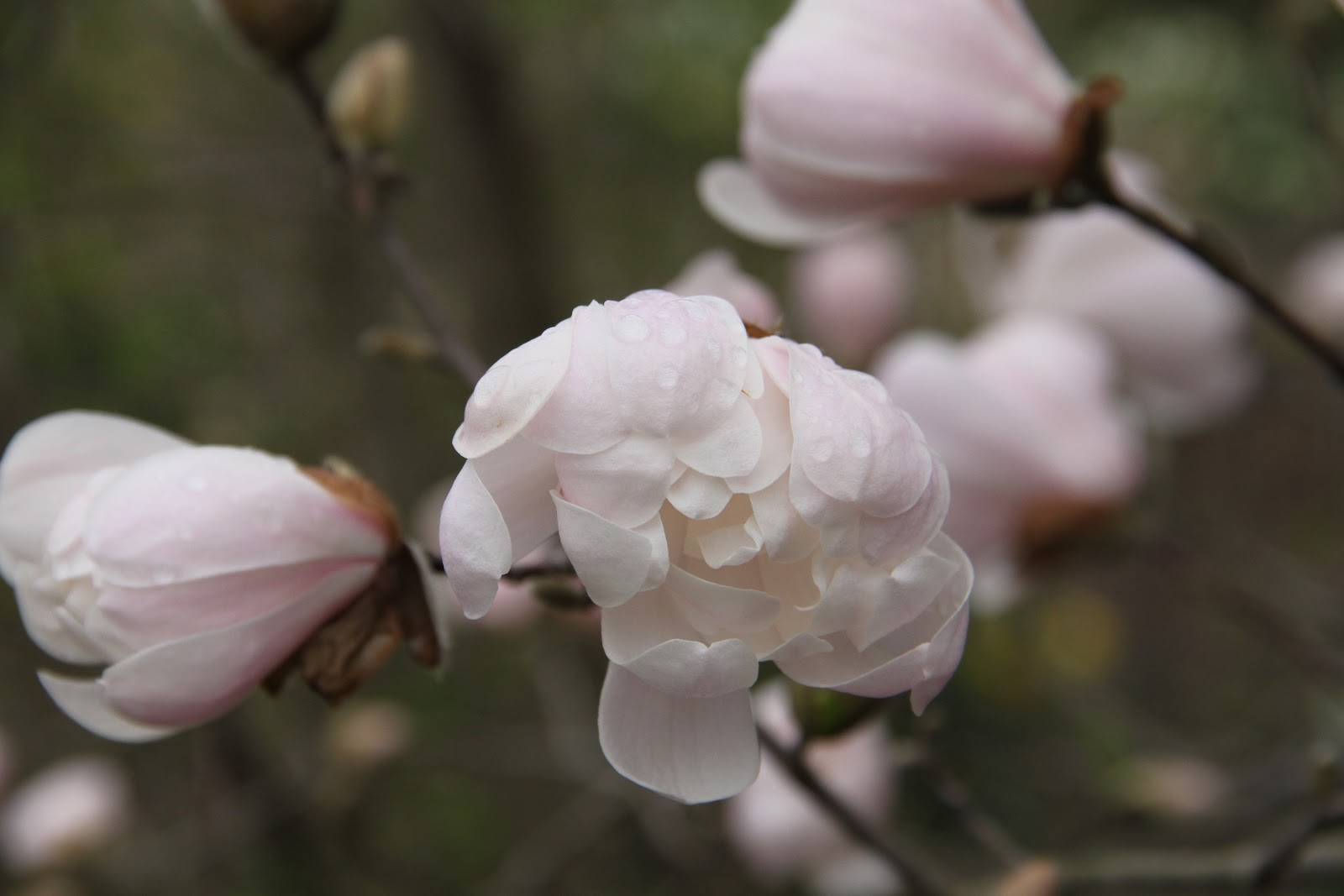
The Unfurling of Spring
Tuesday, March 26, 2013
What's Wrong with this Picture?

That's right...nothing! I went to a local garden center to buy some seed packets. Castor beans, kohlrabi, sunflowers and nasturtiums. A great selection of seed suppliers from around the country. And then I discovered their .10 seed packets from 2012. The germination might not be 100% but that's ok. 749 seed packets later...look out 2013 garden...you're gonna ROCK!
Wednesday, March 13, 2013
Planning this Year's Garden
 |
| Planning the Garden from the January 1906 issue of Garden Magazine |
This time last year it was 80 degrees. Way too warm for an early March day in northeastern Illinois. Now we're back to almost a real winter--24 degrees and big gusty winds. And that sends me back to the seed catalogs. So many things to order that I can't find in the garden centers just yet.
A seed blocker so I can make my own cubes of soil (and thus skip the pots). And some Painted Lady runner beans. And some new zinnias for the butterflies. And chardonnay. For when everything is blooming in June.
It's the Chicago Flower & Garden Show this week. The Art of Gardening. Looking forward to it as the last bit of snow melts off the vegetable garden.
Wednesday, January 23, 2013
Winter. Birds. Robins to be specific.

A fork in the road. A pair of robins have been in our garden since Monday. A few more weeks and the red-winged blackbirds will be back by mid-February.
Saturday, January 5, 2013


Wednesday, December 26, 2012
 As the year draws to a close, it's a time to reflect. I'm thankful for family and friends and fellow gardeners. I'm thankful, too, for past shows like The Victory Garden (the version that ran from the late 1980s through the 1990s) and for folks like Jim Wilson and Peter Seabrook who inspired me through the gardens and the gardeners they explored. Here's what other gardener-friends have been thankful for in years past...
Father knows best
Bigger. Better. More bloom power. That’s what plant hunter Tim Wood of Spring Meadow Nursery in Grand Haven, Michigan was looking for when he developed the new must-have Hydrangea ‘Incrediball,’ which produces gigantic flowers on strong upright stems. And when he’s not developing his own plants, he’s traveling across the world searching out new, promising selections for the Proven Winners brand. “I got into this because my dad was a horticulturist. He was in charge of landscaping at Ford Motor Company, overseeing their world headquarters in Dearborn. He also had a nursery that specialized in unusual plants and I would take care of it after school, weekends and during the summer. In many ways I hated it. Hard work, dirty and long hours. But what I loved was learning and growing new and unusual plants. He gave me an appreciation and love for all types of plants.” Follow Tim Wood on his plant hunting blog at http://plant-quest.blogspot.com/ Enter stage right
Landscape architect Scott Mehaffey credits his grandparents with instilling an interest in gardens. Now director of project development with the City of Chicago’s Natural Resources and Water Quality Division, Mehaffey says, “My maternal grandparents were part of the ‘back to the land’ movement after WW II. They built their own house, planted an orchard and a huge garden, grew berry bushes in the woods and made their own cider. My grandfather died when I was two and I spent the better part of my childhood helping my grandmother take care of the property.” But his defining moment came as a theater major in college. “I had been designing and building sets, setting lights and running sound boards when I realized that I wanted to make real places that would last longer than a few weeks. I picked up the debut issue of Garden Design magazine and I was hooked. I do think my tech theatre background still influences me--I pay a lot of attention to scale and perspective, architectural style and site furnishings--and to lighting of course.” Good Read: “Elements of Garden Design” by Joe Eck (North Point Press, 192 pages, $15.00)
Lilies of the field
Jim Ault’s gardening roots likely started in his parent’s large vegetable garden. ‘I was the only one of three brothers who volunteered to work in there. I even learned to tolerate beets,” says Ault, plant breeder and director of ornamental plant research at the Chicago Botanic Garden in Glencoe. “My grandmother, too, was an extraordinary fern grower--starting plants from spores--and I remember visiting her in Miami when I was a college student and getting up early to walk around her garden.” Ault spends a lot of his leisure time breeding lilies. “My wife and I stumbled on the lily show at the Botanic Garden and we were blown away.” Their backyard in Libertyville, Ill., has become a lily breeding ground. He joined the North American Lily Society and the Wisconsin-Illinois Lily Society and has read everything about lilies from garden magazines to scientific journals. “The whole plant breeding thing gets under your skin and I can’t walk away from it at the end of the day.” Learn more at www.lilies.org .
From soup to [coco]nuts
Sue Miller’s gardening roots run deep, starting with family visits to her German grandparents home in Iowa where castor beans, morning glories, peonies, phlox, petunias and an assortment of vegetables filled the garden. “The green beans and peas tasted so wonderful straight off the vines, which, at the time, were taller than I was,” says Miller, a horticulturist who lives and gardens in Geneva. When she was age 6, her grandfather gave her a grapefruit tree that he had grown from a seed in a soup can. “I still have this tree. It reaches the ceiling and takes up half of my front room. I've kept it alive at least 40 years.” Family vacations in the 1970s took her to exotic places with unusual plants. “My dad was a pilot so we flew a lot when I was young. He flew in WWII in the Pacific near Papua New Guinea so we traveled to Mexico, Hawaii, Australia, Fiji and Papua New Guinea. In New Guinea we stayed about a month with the Missionaries of the Sacred Heart. It was a great experience that I will always remember. This is where I found my love for tropical plants and crazy, wild gardens.” Check out rare and exotic tropical plants for indoors at www.glasshouseworks.com
The apple never falls far from the tree
When garden book author Stephanie Cohen was 5 years old her parents started a Victory Garden in New York city. “It was the Second World War and they wanted to be patriotic,” says Cohen of Collegeville, Penn. After planting too many vegetables they gave produce away in a little red wagon. “We fed the neighborhood. Veggies were boring because I didn't like to eat them, so I had a tiny piece of land where I planted exotic plants--petunias, marigolds and geraniums. This was the start of my long-term romance with ornamentals. Three books, hundreds of articles and lectures, and 21 years of teaching horticulture. I never found the cure for this obsession and probably never will.” Check out her book, “The Nonstop Garden: A Step-by-Step Guide to Smart Plant Choices for Four-Season Designs,” by Cohen and Jennifer Benner. (Timber Press, 248 pages, $19.95.)
...Happy New Year...
Subscribe to:
Posts (Atom)